Buy box setup and screening
AQ-101Your buy box encoded once, then every listing or lead scored against it and tracked in one pipeline.
You get: Buy box, Pipeline tracker, Screen record

Acquisitions
Any asset type: land, income property, condo inventory, SFH portfolios, other CRE, and property under a judgment, in foreclosure, behind a note or bank owned. Screening, underwriting and max price, offer strategy, due diligence, the IC memo, closing and the asset handoff.
Who it is for
Fees. Flat per task or phase, or a recurring monthly fee. Never contingent on a closing.
Asset types
Services by phase
Take one step, like a check of the seller's T-12 before the LOI, or the whole deal from screen to asset handoff.
Your buy box encoded once, then every listing or lead scored against it and tracked in one pipeline.
You get: Buy box, Pipeline tracker, Screen record
Owner, title and liens from public records, court status, entity, zoning, quick comps and a back-of-envelope value, with a pass, hold or kill call.
You get: Desktop review, acquisition, Desktop review, ground-up, Worked example
Hold or value-add model with taxes reset on the price, sensitivity and a max price solved against your hurdle.
You get: Acquisition model with Max bid tab, Underwriting summary, Worked example
Residual land value under each program that fits, with the max price set by the program that wins.
You get: Program models, Underwriting summary
Unit-by-unit pricing, carry and assessments, sellout pace and bulk discount, with the association's budget, reserves and inspections read.
You get: Acquisition model, Condo associations one-pager
Each house priced on its own condition, rent and value, then rolled up with portfolio costs and a portfolio bid.
You get: Acquisition model
Seller T-12 and rent roll rebuilt into a clean, comparable format, tied out, with one-time items and loss to lease called out.
You get: Normalizer workbook
Like-for-like rent comps by unit type, with concessions and amenities adjusted, for the in-place and renovated rent case.
You get: Rent survey template, Worked example
Price versus max, deposit, diligence period, closing date and contingencies set out as a strategy, with an LOI drafted for the client to send.
You get: LOI template, Worked example, Decision memo
Investment committee memo drawn from the same numbers as the model: the deal, the plan, price versus max, top risks and what diligence must prove.
You get: IC memo template, Worked example
Request list by asset type, a tracker with owner, due date, status and finding for each item, and a weekly open items list.
You get: Request list, Tracker, Checklist by deal type, Worked example
A data room built to a standard index so every report, lease and contract has one place and one name.
You get: Data room index
Every party in title searched with name variants, every hit pulled and cleared or priced, and every line logged.
You get: Search worksheet
Findings that move cost or value fed back into the model, with a reprice, proceed or walk recommendation.
You get: DD summary memo, Worked example
Price, deposits, hard dates, contingencies, reps, remedies and closing conditions pulled into one abstract with page cites and every date on the calendar.
You get: PSA abstract
Closing checklist run to the closing date: title, survey, payoffs, estoppels, funds and documents, each with an owner.
You get: Closing checklist, Close and package outline
Renovation scope and cost, renovated rent premiums, occupancy path, operating costs with insurance and taxes called out, hold period and exit.
You get: Business plan tabs, Business plan summary
Package for the asset manager or property manager: data room, open items, first-year budget, renovation schedule and the reporting template.
You get: Data room index, Handoff memo and open items list
A negotiated purchase before the sale date, priced around the judgment, the liens that survive and the lender's likely position.
You get: Desktop review, acquisition, Search worksheet, Decision memo
Bid ceiling built up from value as is, less surviving liens, code cures, rehab reserve, holding and exit costs and margin, with the likely credit bid estimated and pre-sale diligence done.
You get: Bid sheet, Sale log, Model with Max bid tab
Note priced as a share of unpaid balance and compared with buying the deed, adjusted for time to title, legal, receiver, NOI collected and doc stamps; collateral file reviewed.
You get: Note vs deed tab, Collateral file checklist
Offer package to bank and special servicer standards: proof of funds, deposit, few contingencies, the bank addendum read and a repair cushion carried.
You get: LOI template, Decision memo
How a deal moves
Each gate states what passes, what kills the deal, and the file that comes out. Nothing moves without a sign-off. Times are for a negotiated deal; auctions run on their own track.
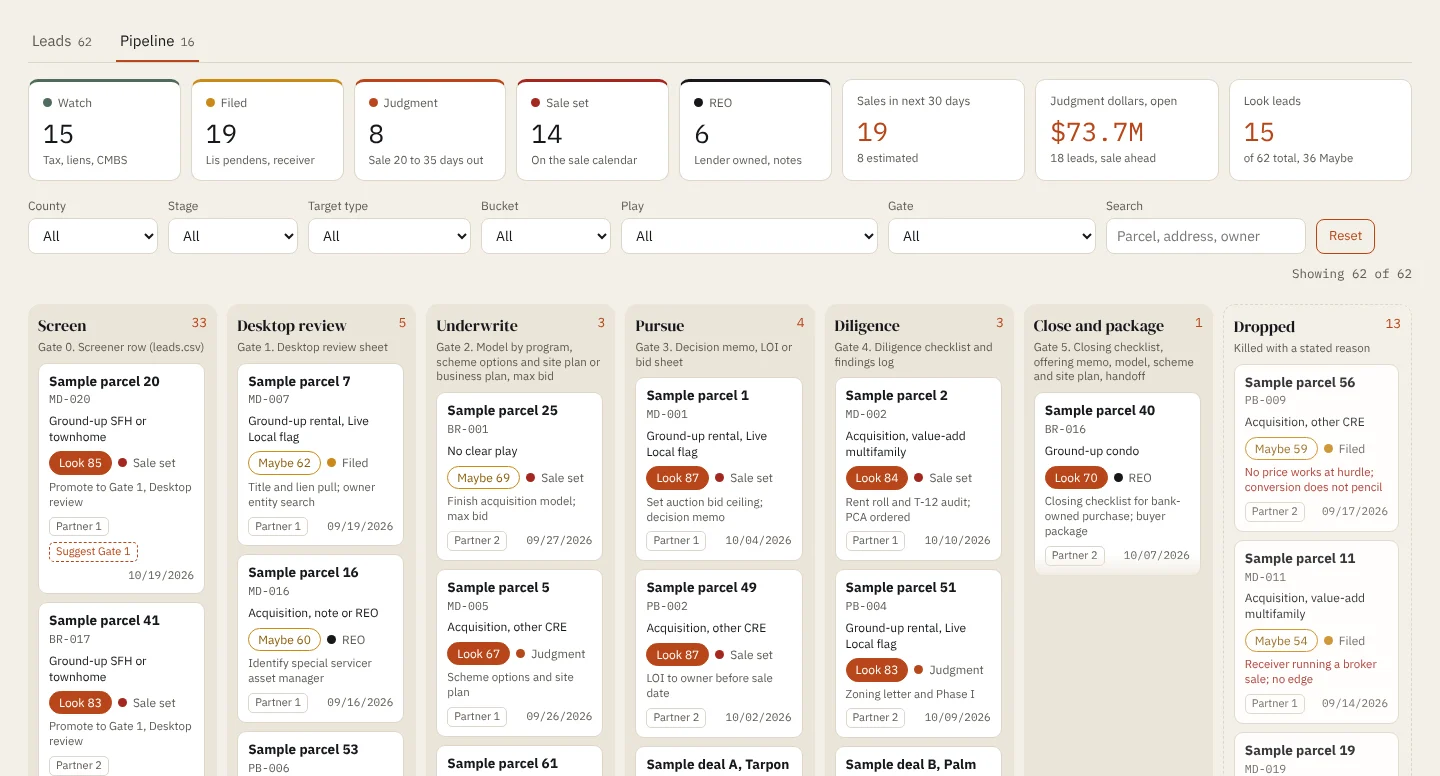
Pipeline board, Screen to Diligence. Every deal at its gate, every kill with its reason. Sample data, fictional leads.
Underwriting and pricing
The bid is solved from the hurdle, then the model is rebuilt at that bid to confirm the binding test lands on target. Surviving taxes and liens come off the top. Every return names its metric.
UYOC (stabilized NOI / TDC), 150 bps over the exit cap. TDC includes interest and fees. Podium schemes need 40% overall efficiency, garage included.
Profit margin, plus unlevered IRR, EM and payback. A higher bar for presale, completion and closing risk; under 15% is a pass.
Profit margin; under 15% is a pass. Shorter, phased build.
UYOC (stabilized NOI / total basis). Taxes reset on the price.
Hurdles are the defaults in the sample models; each deal sets its own. Ground-up timelines start at construction start; acquisitions start at closing.
The offering memo, the gate files and the live model. Tap a page to open it full size.
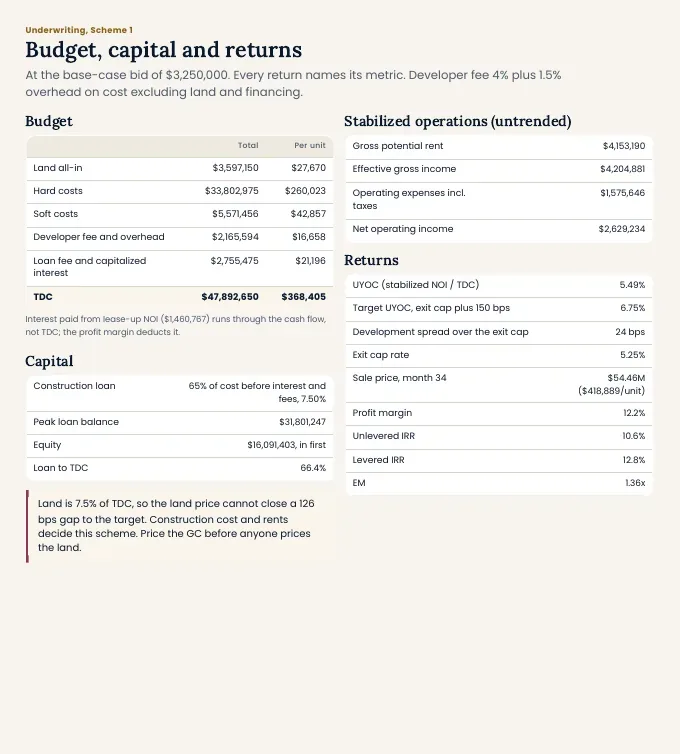
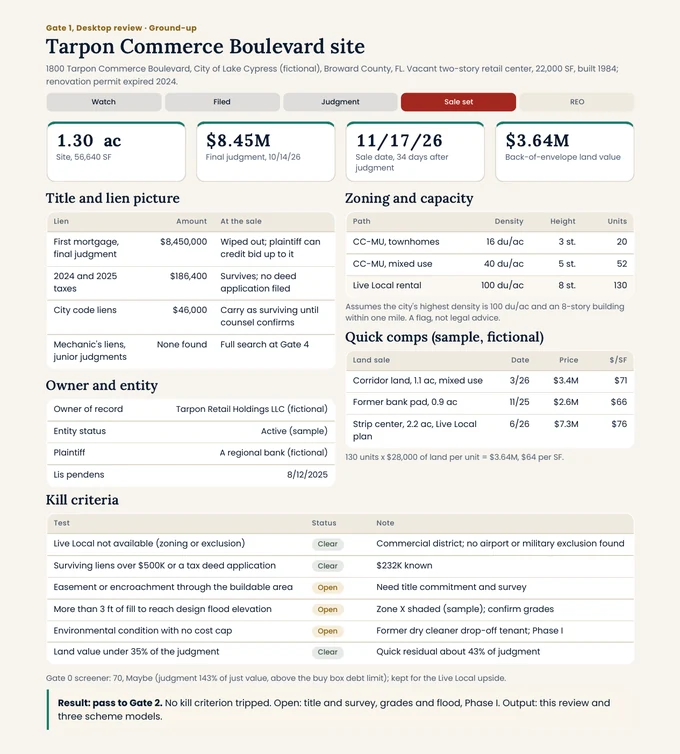
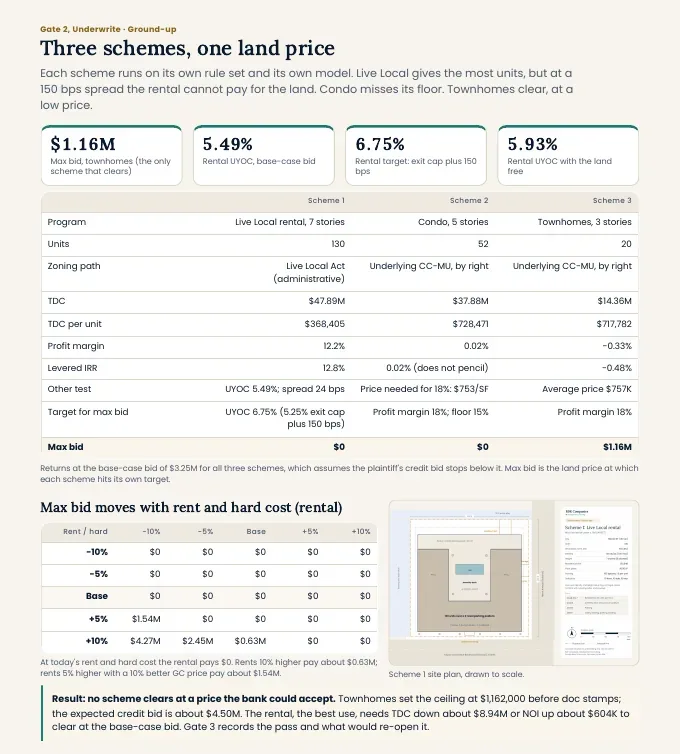
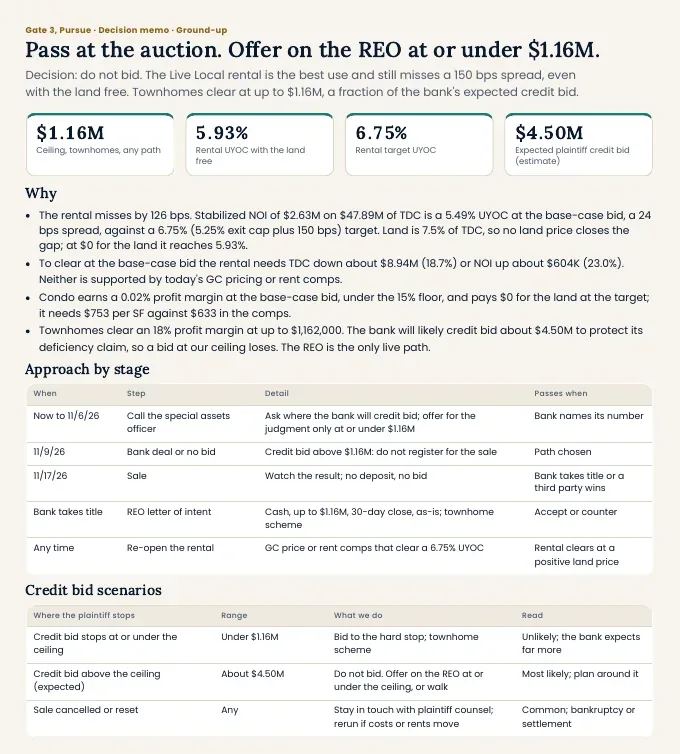
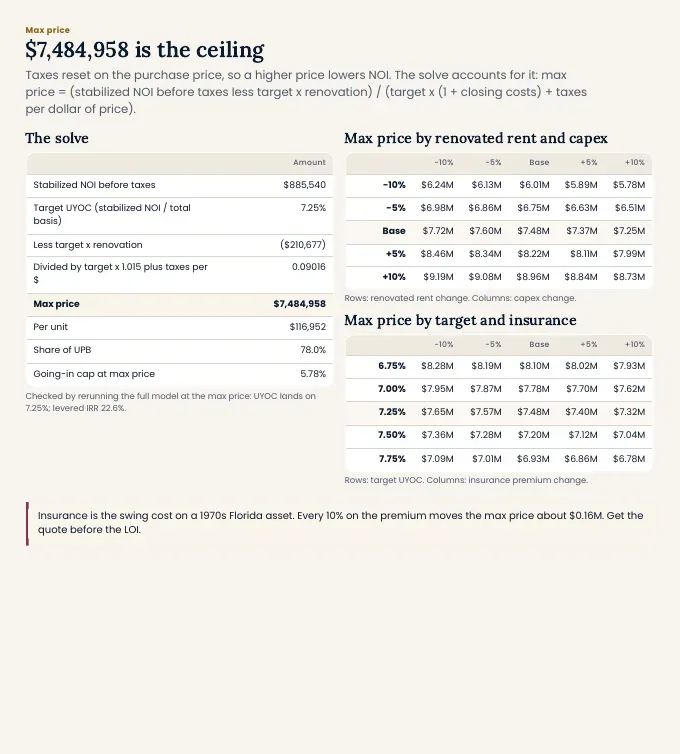
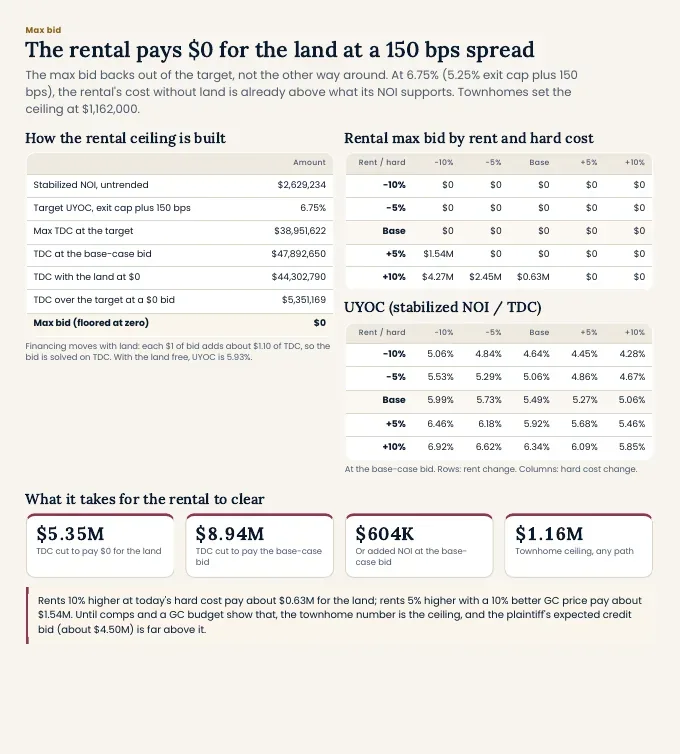
Sample deal, fictional site. Estimates, not an offer.
Sample deals
One ground-up, one acquisition. Fictional sites, real method.
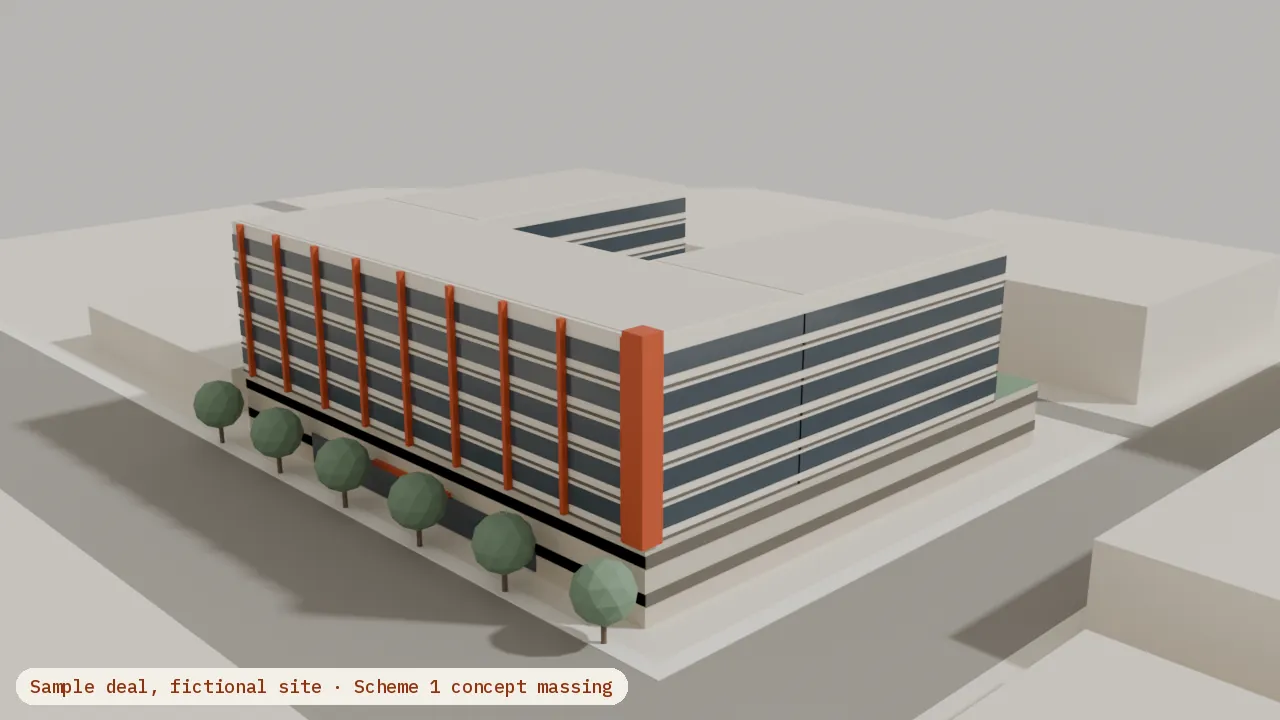
A vacant 1984 retail center on a 1.30-acre corridor lot, renovation permit expired. Final judgment for a regional bank; sale set for November 17, 2026. Three schemes tested. At a 150 bps spread the Live Local rental cannot pay for the land; townhomes clear, far under the bank's expected credit bid. The call: no bid at the sale, an REO offer or a walk.
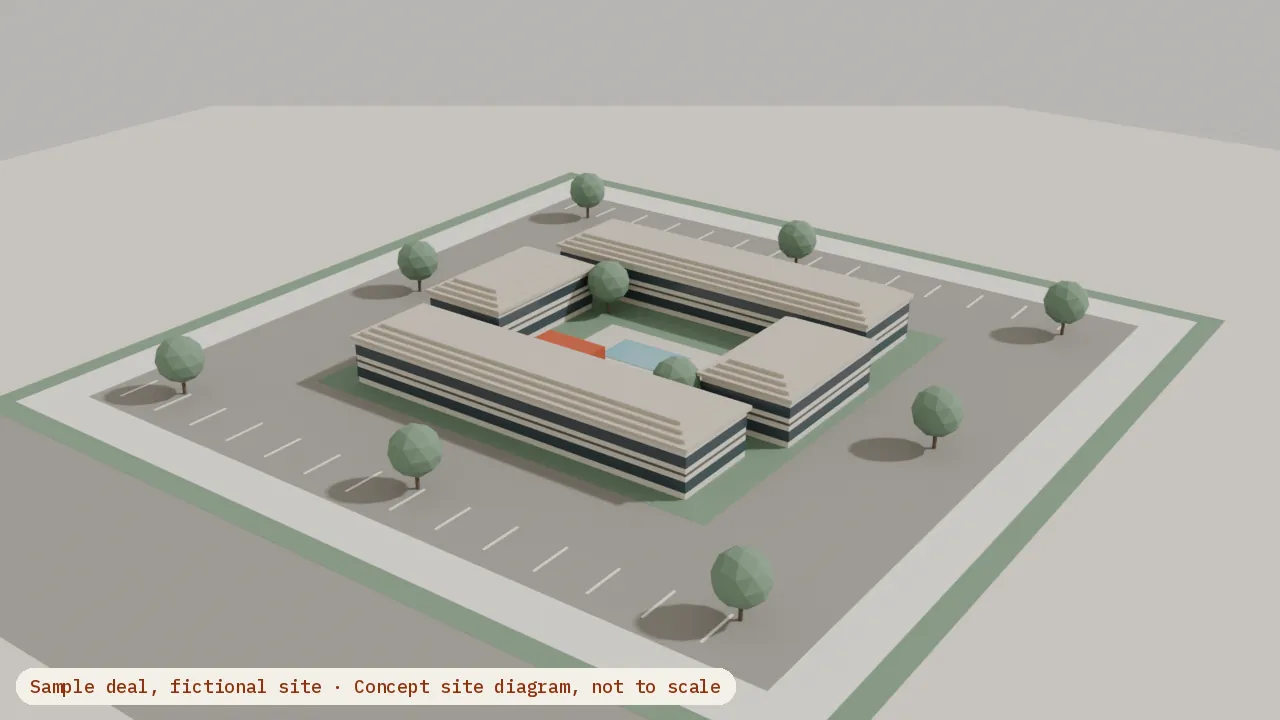
64 garden units on 3.40 acres, built in 1974. A 2019 CMBS conduit loan matured, went to special servicing and is now in foreclosure. Under-managed, under-rented, not broken. Buy the deed at a discount to the debt, renovate, refinance, sell.
Distressed paths
The approach matches the stage. At auction, the bid ceiling is set before sale day. On a note, the price is tested against buying the deed. On REO, the offer comes with a package the bank's special assets team can approve quickly.
The auction track
The negotiated times do not fit a foreclosure sale. Once the judgment is in, Gates 1 to 4 squeeze into the days before the sale, and diligence shrinks to what can be done from outside the fence. Survey, Phase I and PCA usually cannot happen before the sale, so that risk goes into the ceiling as a cushion.
Sales get reset or cancelled all the time. We check the docket the day before and the morning of. The bid ceiling is set before sale day.
The plaintiff can bid up to its judgment without bringing cash. If the lender's credit bid will run past our ceiling, we stop and look at a note purchase or an assignment of bid before the sale instead.
Sale set 20 to 35 days out under Fla. Stat. 45.031, unless the plaintiff agrees to a later date or the sale is reset.
Title and liens from the public record, owner, zoning, quick comps.
Model by program and the max bid. Surviving taxes and liens come off the top.
Ceiling signed off. The deposit is ready on the county's deadline, and funds are in cash.
Title, liens, taxes, code cases and flood. Sales are as is, usually with no interior access.
Docket re-checked that morning for a cancellation, reset or bankruptcy filing.
Issued if no objection is filed. Record it, pay doc stamps (confirm with the Clerk), order the owner's title policy.
Auction rules as of October 2026; confirm with each county before bidding. Public record review only, not a title search. Lien survival, judgment periods and insurability are planning research; confirm with title counsel.
Engagement models
A single task, a single phase, a point in time, or start to finish. Fee structure only; rates go in the proposal.
Turnaround: 3 to 5 business days
Fee: Flat per task
Turnaround: 30 to 60 days
Fee: Flat per phase or recurring monthly fee
Turnaround: 2 business days
Fee: Flat per task
Turnaround: Deal by deal, about 3 to 6 months
Fee: Recurring monthly fee
Fees and terms
Rates go in the proposal and the engagement letter, scoped to the work. The structure is the same for every client.
Flat fee per task. Flat fee per phase. Or a recurring monthly fee while a deal or a pipeline is live.
The fee is the same whether you buy, pass or get outbid. Finding a seller, negotiating for you or marketing a property is brokerage, and runs only under an agreement with [Brokerage Name].
Contact
Tell me what you have and where it stands. I will tell you which vertical and engagement fit, and what it takes to get you an answer.
Clients and pilot users: run jobs, track agents and download results.