Pipeline walk and setup plan
SY-101Your projects, templates, consultants, jurisdictions and the mistakes your team has made before, turned into a build plan.
You get: Setup checklist, Launch checklist

Systems
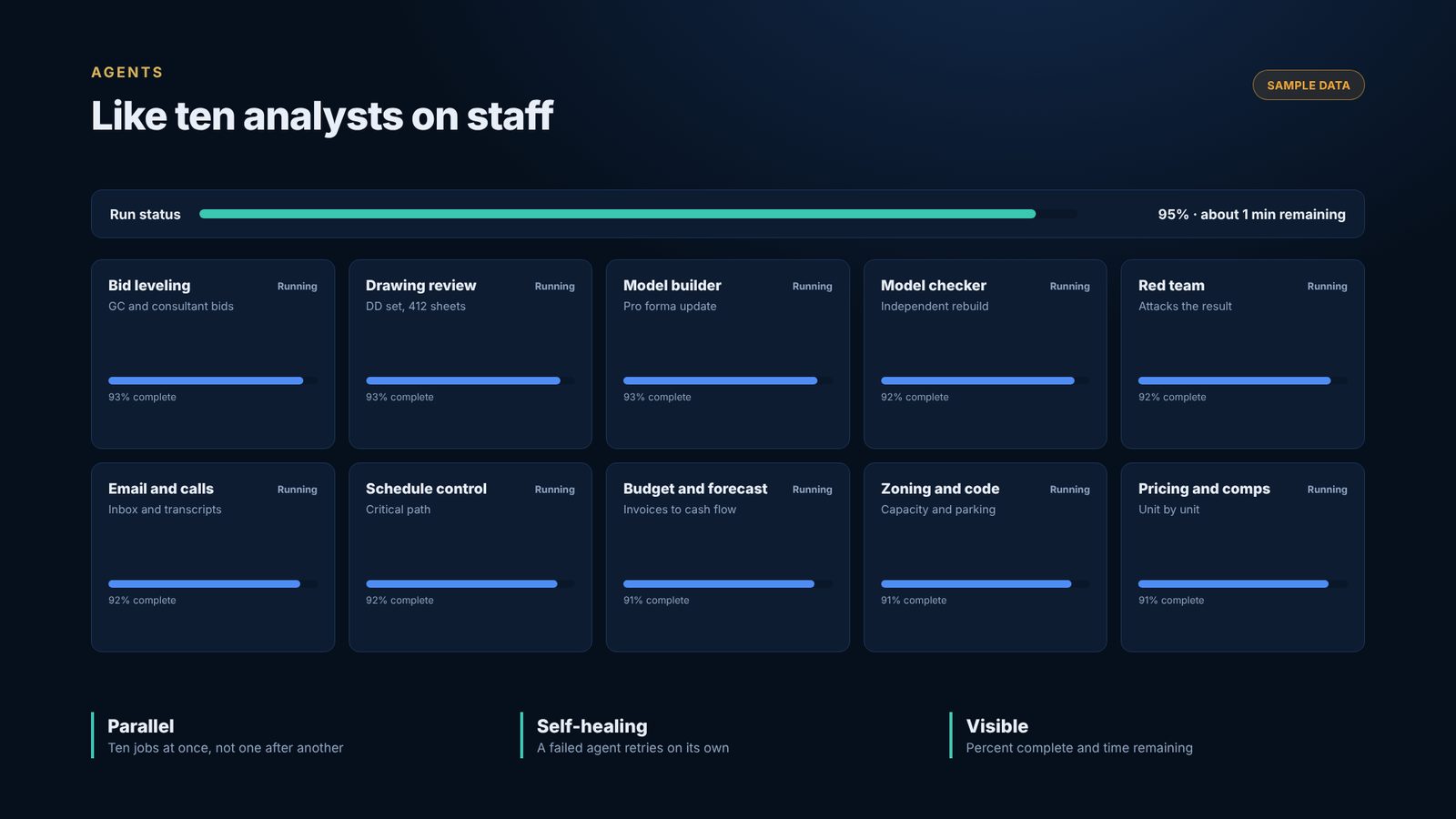
The development operating system, built inside Claude by a working developer on live projects, installed for your firm. It reads your email, calls, files, schedules and budgets, runs the analyst work in parallel, checks itself before anything reaches you, and gets better every week.
Who it is for
Fees. An install fee plus a recurring monthly fee. The engine runs on our secured server under a license.
The economics
The system takes the analytical work down by about 80% and the coordination by about 60%. The meetings, site walks and judgment calls stay with your people.
| Weekly hours per active project | Before | With the system |
|---|---|---|
| Pro formas, budgets and cash flows | 4 | 0.8 |
| Bid and consultant leveling | 3 | 0.6 |
| Drawing and document review | 3 | 0.6 |
| Schedules | 2 | 0.4 |
| Reporting to ownership and partners | 2 | 0.4 |
| Email, follow-up and coordination | 5 | 2 |
| Meetings, site and judgment | 4 | 4 |
| Total per project | 23 | 8.8 |
At a 50 to 55 hour week: about 2.3 projects per development manager before, about 6 with the system. Hours are estimated from the builder's own projects; a paid proof measures them on yours.
Keep your best development managers, give each of them 2 to 3 times the projects, and either cut the payroll or double the pipeline with the team you have.
| 20 active projects | Today | With the system | Annual cost freed |
|---|---|---|---|
| Development managers, about $200K fully loaded | 8 | 4 | $800K |
| Analysts and associates, about $130K fully loaded | 4 | 1 | $390K |
| Payroll freed each year | 12 | 5 | about $1.19M |
Illustrative, before the cost of the system, which is quoted per firm. Compensation is fully loaded (salary, bonus, benefits and taxes) and runs above public averages for Miami to reflect senior staff at established firms.
Agents
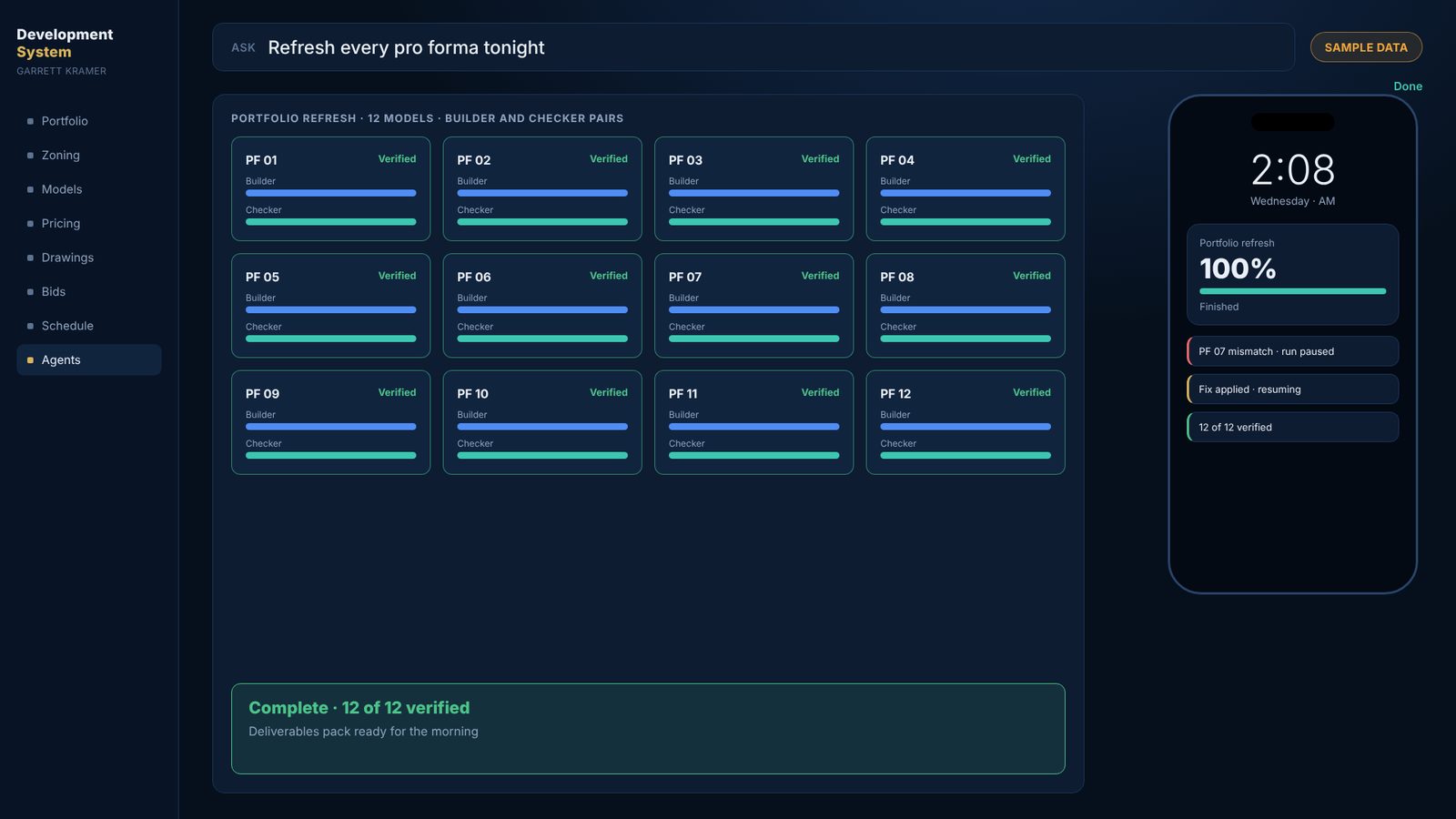
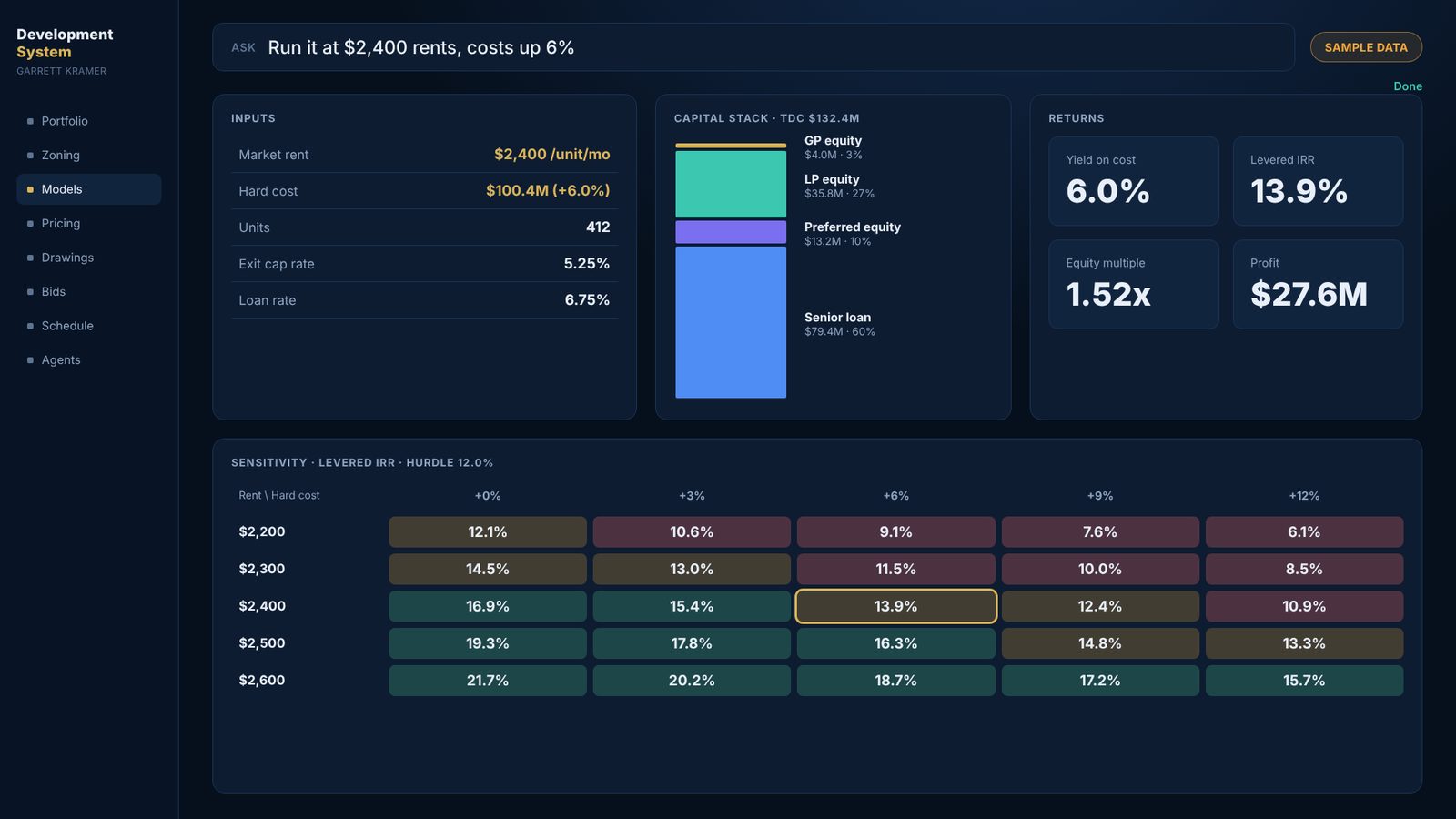
Behind every request, the work is split across specialist agents that run in parallel and check each other.
Services by phase
Start with a walk through your pipeline or a paid proof on one project. Install, launch on a live project, then run and improve it every month.
Your projects, templates, consultants, jurisdictions and the mistakes your team has made before, turned into a build plan.
You get: Setup checklist, Launch checklist
A 30-day paid proof on one live project that measures the hours returned and the issues caught.
You get: Trial agreement, Proof scorecard
Your standing rules, program rule sets and a skill for each kind of work, written so every job reads them first.
You get: House rules file, Skill set: screen, underwrite, IC memo, DD tracker, drawing review, draw review, owner report, red team and more
The plugin added to your Claude account through a private marketplace and connected to the engine with an access key.
You get: Client install guide, Admin setup guide, Data handling summary
Your models, checklists and report templates set up in the house format, with inputs to change in blue.
You get: Program models, Gate kit
Recurring jobs set to run on a schedule or on demand, each with its own rules and a plain-language trigger.
You get: On demand jobs, Weekly run prompt
The system run on real work with your team, refined until it holds up, then rolled to the next project.
You get: Go-to-market and rollout plan
Training for the team and setup of Claude Team or Enterprise: organization skills, review of new skills, connectors and access.
You get: Admin setup guide
Weekly review of what ran, what failed and what went stale; monthly tuning and a scorecard you can hand to ownership.
You get: Monthly scorecard
When a mistake surfaces, the fix is applied everywhere it spread and turned into a dated rule or a new skill, with approval before anything changes.
You get: Dated rule and skill log
The scoring, modeling and checking engine on our secured server, licensed per firm, with keys issued, rotated and revoked as your team changes.
You get: Terms of use, Privacy policy, Data processing notes
A review of an existing Claude setup: rules, skills, jobs and failure points, with a ranked list of fixes.
You get: Audit memo
The install sets up a house review tool set and a shared status list in Revu once. After that, five role reviewers and a red team review each set, the issue log goes back on the drawings as clouds, and the backcheck reads your markups summary export. Bluebeam Max sells AI drawing review, set comparison and an AI connection; this system does the core of it on Bluebeam Core, with your rules and benchmarks.
Bluebeam Max
$590per user per year, introductory
Bluebeam Core with this system
$330per user per year, plus the system
Prices as listed on Bluebeam's pricing page, October 2026. Bluebeam and Revu are trademarks of Bluebeam, Inc. The Kramer Companies is not affiliated with Bluebeam.
It compounds
When it is corrected, it fixes every place the error spread, then proposes a dated rule or a new skill so the mistake cannot recur. A weekly health sweep reviews what ran, what failed and what went stale, and suggests efficiencies. Nothing changes without approval.
Skills
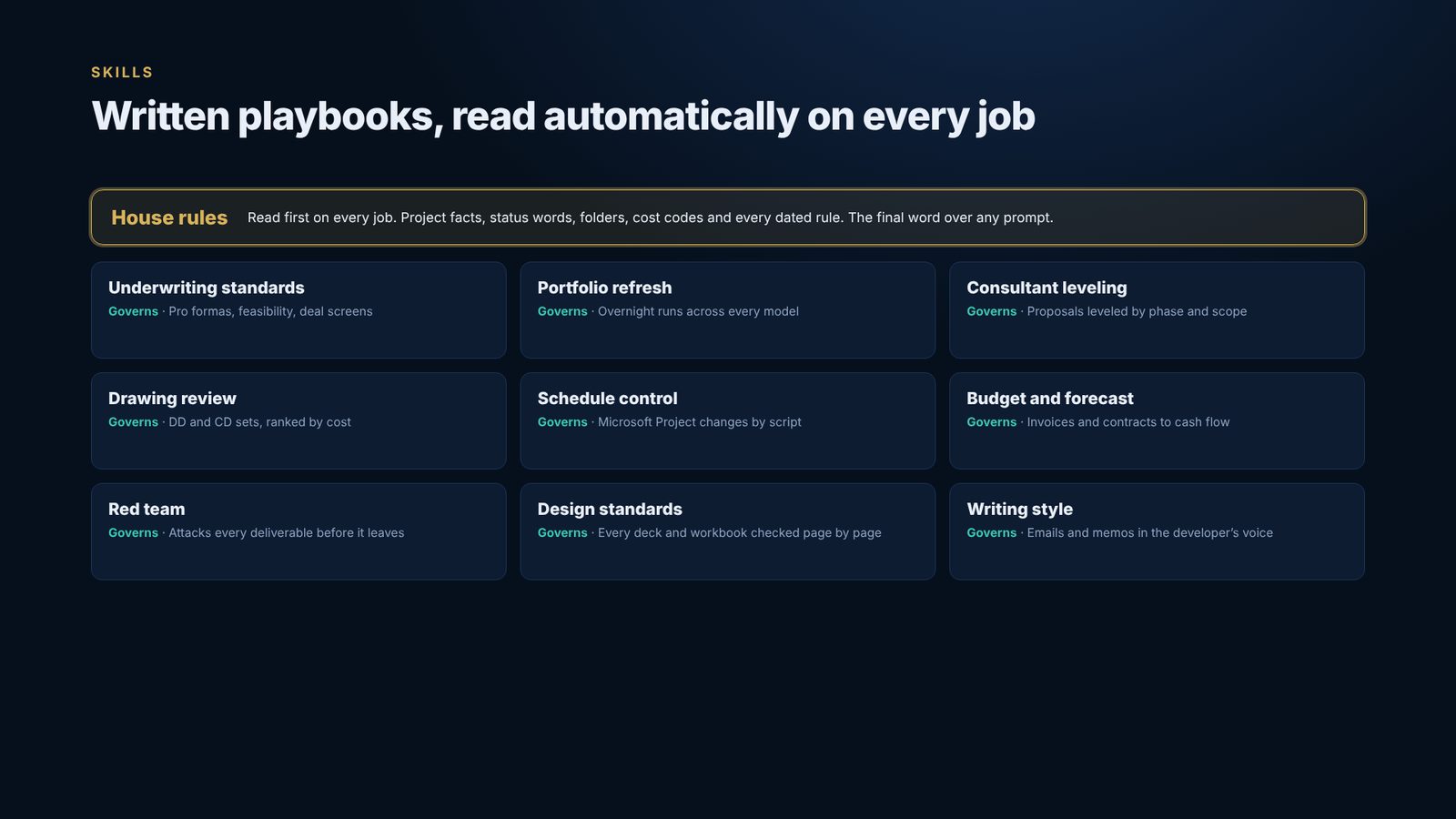
House rules sit above everything and are the final word over any prompt. Under them, a skill for each kind of work: underwriting standards, portfolio refresh, consultant leveling, drawing review, schedule control, budget and forecast, red team, design standards and writing style.
Claude Team and Enterprise
On Claude's Team and Enterprise plans the system stops being one person's setup and becomes the firm's. One person's correction improves everyone's work, and every project rolls up the same way.
Admins push the house rules and skills to every user at once, with a set per team: development, acquisitions, asset management.
New skills can require approval before anyone uses them, so the playbook stays controlled as it grows.
Microsoft 365, Google Workspace and Slack connectors bring email, files, calendars and chat into the work.
Single sign-on, user provisioning, role-based access, audit logs and custom data retention.
Enterprise prompts, files and results are not used to train models by default.
Usage analytics and spend limits by user and organization, so the firm sees adoption and cost.
Plan features per Anthropic's published plan documentation. Availability can change; confirmed at setup.
Build, run, own
| Item | This month |
|---|---|
| Runs completed | 142 |
| Issues caught before reaching you | 9 |
| Dollar value of issues flagged | $2.4M |
| Team hours returned | 186 |
| New dated rules and skills | 4 |
| Failed runs, found and fixed | 3 |
Illustrative figures for a 6-project team.
Engagement models
A single task, a single phase, a point in time, or start to finish. Fee structure only; rates go in the proposal.
Turnaround: 1 to 2 weeks
Fee: Flat per task
Turnaround: 4 to 6 weeks
Fee: Install fee
Turnaround: 1 week
Fee: Flat per task
Turnaround: Install in 4 to 6 weeks, then monthly
Fee: Install fee plus recurring monthly fee
Fees and terms
Rates go in the proposal and the engagement letter, scoped to the work. The structure is the same for every client.
One-time install fee. Four to six weeks from signing to live, on one of your projects.
Recurring monthly fee for run, support and the engine license. Scoped to the number of projects and users.
Contact
Tell me what you have and where it stands. I will tell you which vertical and engagement fit, and what it takes to get you an answer.
Clients and pilot users: run jobs, track agents and download results.